
Loretta Sebastiani

Panettone with fresh yeast
(
Panettone con lievito di birra
)
Our original home cooking
Panettone is a leavened-dough cake well known all over the world but whose origin is Italian. The true recipe for panettone involves the use of sourdough, but today in Italy we are sometimes used to substitute it with fresh yeast. The reasons? It isn't easy to find fresh sourdough and to speed up its recipe. The taste is not the same, remember that! Here's my recipe for panettone with fresh yeast, tested several times.
difficulty: laborious recipe
time: about 2 hours and 20m minutes
calories: 369 (kCal)
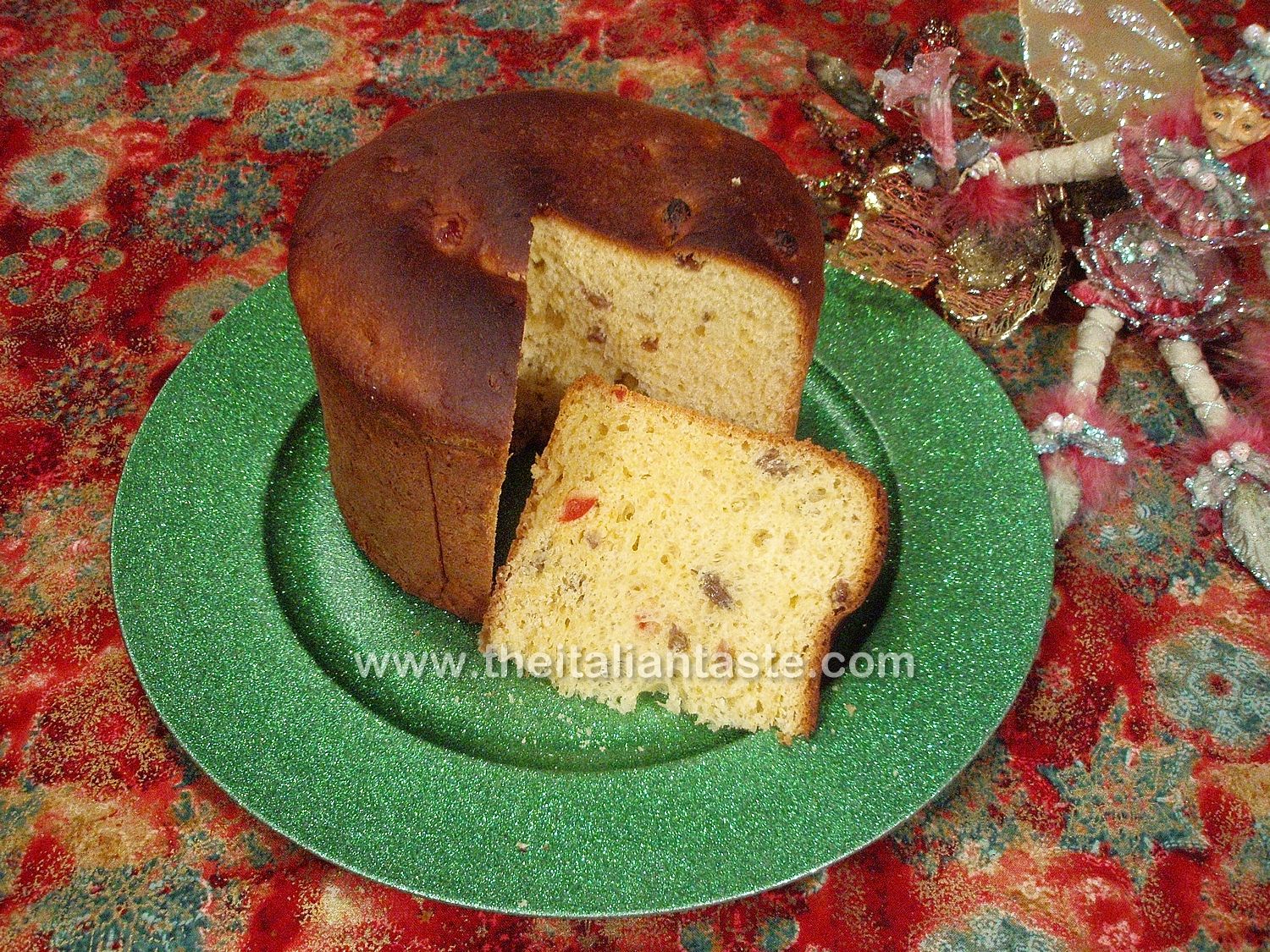
Ingredients / Serves 16
- 750g (1 2/3 pound) all-purpose flour plus more for dusting
- 25g (1 ounce) fresh yeast
- 220g (7 3/4 ounces) unsalted butter
- 4 eggs
- 2 yolks
- 200g (7 ounces) sugar
- 80g (2.8 ounces) assorted candied fruir
- 100g (3 1/2 ounces) raisins
- 2 pinches salt
- 350ml (11.8 fluid ounces - 1 1/2 cup) water
- Difficulty:
- laborious recipe
- Time: preparation: 90 minutes
- How many calories in a serving?
- Calories:
369 (kcal)
19 % -
1546 (kJ)
Protein: 7.5 (g) 15 % GDA
Total fat: 13.7 (g) 20 % GDA
Total carbohydrate: 57.1 (g) 22 % GDA
Sugars: 21.6 (g) 24 % GDA
plus leavening time
cooking: 50 minutes
total: about 2 hours and 20m minutes
Download free PDF version (763 download).


Recipe for panettone with fresh yeast
To make this panettone recipe you'll need: all-purpose flour, unsalted butter, sugar, eggs, candied fruit, raisins and fresh yeast.
Basically it is a genuinely cake made with a few select ingredients that you can also choose among organic products, especially if you have kids.
The main difficulty is to make your panettone leaven well. The leavening must be done in several times.
Here's the recipe as I'm used to do in my kitchen! And do not get scared by the length of my description. I preferred to talk a length to be clearer.
Preparation
- - Begin the night before.
- - Put 100g (3 1/2 ounces) all-purpose flour in a bowl.
- - Melt fresh yeast in 150ml (5 fluid ounces - 1/2 cup plus 2 tablespoons) warm water (about 20°C).
Then add this warm water to the flour in the bow.
Dissolve all the lumps well with your fingers until a smooth dough. - - Plunge a cotton cloth in boiling water. Squeeze it well and cover the bowl with it.
- - Put the bowl in a warm place, away from drafts.
The temperature at home must be high (at least 24 - 25°C). I know that someone will be angry, especially the environmentalists ... but this is an essential condition. If you can not or do not want to adjust the temperature of your house at this level you can preheat the oven to 30 to 50° C, turn it off and then put the bowl in the oven, leaving the light on. That little light keeps the temperature high. It's my real experience! - - The morning after the dough will be more than doubled. Add other flour (120 to 150g) to the dough, directly into the bowl.
The amount can not be accurate because it depends on factors that are beyond our control.
For example, the humidity. I always start with 120g of flour, but I almost always add another 20 or 30g of flour.
The rule is to add the amount of flour that allows you to remove the dough from the bowl and knead it for a few minutes on a work surface. - - Once finished transfer your dough into a larger bowl.
- - Plunge the same cotton cloth used the night before in boiling water. Squeeze it well and cover the bowl with it.
Place the bowl in the same place or in the oven as I've already explained.
I use warm, damp cloth to help the rise and prevent the dough dry on its surface.
- - The second dough should rise for several hours, even six.
Its volume has not only to double but it should increase a lot. The more your dough will rise the softer your panettone will be. - - The leavened dough is ready in the early afternoon.
- - Before kneading your dough for the third time prepare all the other ingredients.
Begin more than an hour before. - - At first dissolve sugar in 200ml (6 3/4 fluid ounces) water in a saucepan and then put the pan in a water bath. Cook it for 45 minutes on a very low heat. Finally you have a smooth, clear syrup that has also significantly reduced its original volume. Then let it cool.
- - At this point add eggs, one at a time, beating your mixture continuously.
Then add yolks too, beating the mixture continuously.
The mixture should be, shortly before adding it to the leavened dough, frothy and warm (not above 20° C). - - Meanwhile soak raisins in warm water (for almost 20 to 30 minutes).
- - Besides cut candied fruit into little pieces if they are too big.
Then dip candied fruit in a little flour and rub them on a pastry board with your hands so that they can't stick together. - - Squeeze raisins and flour them with the same technique.
- - Prepare two pans.
I use a special mold: a non-stick, removable-bottom panettone mold. But if you don't find it you could use any cylindrical pan whose bottom has a diameter 18cm (7in) long and whose side is 10cm (4in) high.
Line their bottom and sides with buttered baking paper. - - Melt 200g (7 ounces) butter in water bath.
Butter should be at a temperature not exceeding 20° C.
If necessary let it cool. - - Prepare 400g (14 ounces) flour, mixed with the salt, on a pastry board.
Make a very large well in its center.
- - Place your leavened dough in the center of the well and pour in butter.
- - Begin to melt the leavened dough in the warm butter with patience and possibly helping you with a little of the flour.
- - When all the leavened dough is well blended into the butter pour in the egg-and-syrup mixture, little at a time, adding gradually the flour too.
- - Put aside 100g (3 1/2 ounces) flour to add, if necessary, together with candied fruit and raisins.
It's difficult to say the real amount of flour depending on many factors.
Anyway I have the best results with a dough that sticks to the pastry board but that is both lucid and compact.
Besides you can lift and detache it with a spatula very easy.
Knead it for few minutes to blend in raisins and candied fruit very well. - - Transfer your dough into the pans helping you with a spatula.
Fill the pans for more than one third.
If the rise and previous steps are well done your dough must triple.
I sometimes have some dough left. I place it in a little mold for a little breakfast cake. - - Now place the pans in the same corner or in the oven in the same conditions I've already indicated. And wait ... till your cakes reaches the edge.
- - Preheat the oven to 180°C (350°F).
Cooking
- - Place the two pans and a little bowl full of water in the oven.
- - Bake for about 40 minutes or more.
The panettone surface tends to be golden almost immediately, and anyway before the end of cooking.
After 20-25 minutes lower the temperature to 160° C and cover the cake with aluminum foil to prevent its surface colors too.
Please do not open the oven for any reason before this moment. I did it and in that case we ate this cake with a nice dimple in the center ... it wasn't my best result!
After 40 minutes check the cooking using a long wooden skewer, which should be dry. If not ready, continue cooking.
Just before serving
- - When cooked turn off the oven and open partially its door. Don't remove your cakes from the oven immediately.
Wait some minutes. - - Let them cool completely before transfering them to serving plates.
Note
Tips
- - I have not specified the time for the third rise. Most of the recipes that you can read on Internet talk about six hours. Usually in my case 3 to 4 hours are enough. But as I have already written the variables are many and you have to test panettone recipe in your kitchen and with your instruments and eventually correct doses and/or times. This means you can not make this cake for the first time on Christmas Eve!
- - Attention to the cooking pan! Do not fall into the error of preparing only one big cake. In our ovens it will never cook well. Prefer always small molds such as those I have suggested. With these doses you'll get two panettone cakes.
- - Another problem is to calculate how long before you can prepare it. I suggest the day before.
Once cut, store it in a plastic bag for food. - - I have also tried to freeze it in individual slices for no longer than a month. The result is encouraging. When you'd like to eat your frozen panettone it's enough to thaw it at room temperature and then warm in the oven (a few minutes at 50°C). Of course, it becomes a delicious cake for your breakfast.
- - Another recommendation. Do not let anyone diddle you with the promise of faster times by increasing simply the amount of fresh yeast. Panettone was created as a slow-rise cake in which the yeast must be the sourdough. It is already a strained interpretation to do it with fresh yeast. But if the fresh yeast is too much your panettone could have an acidic aftertaste. The same thing happens doing the pizza dough where the yeast doses compared to the flour must be respected if you want to serve a really good pizza.
- - Some of you may think that 200g (7 ounces) sugar compared to 750g (1 2/3 pound) flour are very few but this is precisely the characteristic of panettone. The mixture can not be too sweet otherwise it is no more the cake everyone in the world calls panettone. Its sweetness must come from raisins and candied fruits more than the sugar in the dough.
Menu planning
- - How to serve the cake? Bring the whole cake at table and slice it directly on the table. Serve on a plate without dessert cutlery. In general, you can eat panettone with your hands. It should never be bitten directly. Remove a bit with your hands and bring it to your mouth. If the cake is stuffed it is necessary a dessert fork. But I consider it a "crime" and a further attack on health. Panettone is already so good that it does not need additional creams
- - Remember that ultimately it is suggested to prepare the panettone cake (Italian Christmas bread or pudding) even in summer. The presence of butter makes it can be fully appreciated in summer too!
Useful links for this recipe
- - Here's the recipe for pizza dough if you want to consult the correct doses for yeast and flour.
- - Are you interested in recipe for panettone with sourdough? or panettone with emmer flour?
Healthy eating
- - Panettone is rich in calories as all sweets. You can't be surprised: it is full of nutrient ingredients (flour, eggs, butter, sugar, raisins and candied fruit).
You should not eat panettone frequently in the holiday season otherwise it is easy to gain weight ;)
Loretta
What's the right wine for " Panettone with fresh yeast "?
Match a dessert or a sparkling wine with panettone such as Asti Spumante DOCG if you need bubbles to celebrate or Asti moscato (both wines of Piedmont)